

Tax-Aware Planning
Your investments, your taxes, and your CPA,
working from the same picture.
What “Tax-Aware” Means
Most investors have two professionals who rarely talk: an advisor who manages the portfolio and a CPA who files the return. Decisions get made in one room and discovered in the other, usually in April.
Tax-aware planning closes that gap. We look at how your investments, income, accounts, and giving interact with your tax return, and we plan around it throughout the year rather than reacting after it ends.
What this is, and what it isn’t. We provide tax-aware planning: modeling scenarios, identifying opportunities, and coordinating decisions. We don’t prepare tax returns, and we don’t replace your CPA. Your CPA remains the authority on your return, and we make sure the two of you are working from the same numbers.
How It Works: The Planning Year
Tax planning isn’t a once-a-year event, so we organize it around the calendar:
Spring: Return Review. We review your filed return for opportunities and anything worth acting on this year.
Summer: Mid-Year Check-In. We compare actual income and gains against expectations while there’s still time to adjust.
Fall: Year-End Planning. This is where most of the action is: harvesting, Roth conversion analysis, charitable giving, and income timing.
Winter: Filing Prep. We organize and share the documents your CPA needs so filing goes smoothly.
Working With Your CPA
Our approach is built on 10+ years working alongside CPAs, and on understanding what each side sees that the other doesn’t. Your CPA knows your return in detail. We know your portfolio, cash flow, and long-term plan. Together, that’s the full picture.
In practice, this means:
With your permission, we share relevant information with your CPA, and we ask for theirs
Year-end and mid-year strategies are reviewed with your CPA before they’re implemented
Questions get routed to the right person, so you’re not the messenger between us
Don’t have a CPA you’re happy with? We’re glad to work with your existing one, or introduce you to professionals we trust.
Key Topics
Account Location: Which assets belong in tax-deferred, Roth, taxable, or health savings accounts
Tax-Loss Harvesting: Turning market dips into tax planning opportunities, and the rules to watch
Roth Conversions: When paying tax now may make sense, and when it may not
Charitable Giving & Donor-Advised Funds: Making giving intentional and tax-efficient
Concentrated Stock Positions: Hold, sell, or hedge, and the tax consequences of each
Retirement Income & RMDs: Sequencing withdrawals to manage the tax drag
Business Owner Considerations: Entity choices, sale planning, and liquidity events
How you take money out matters as much as how you invest it.
Two households with the same portfolio can end up with very different after-tax results depending on which accounts they draw from, and when. This short video explains why a tax-efficient distribution strategy matters, and it’s the kind of planning we build into every client relationship.
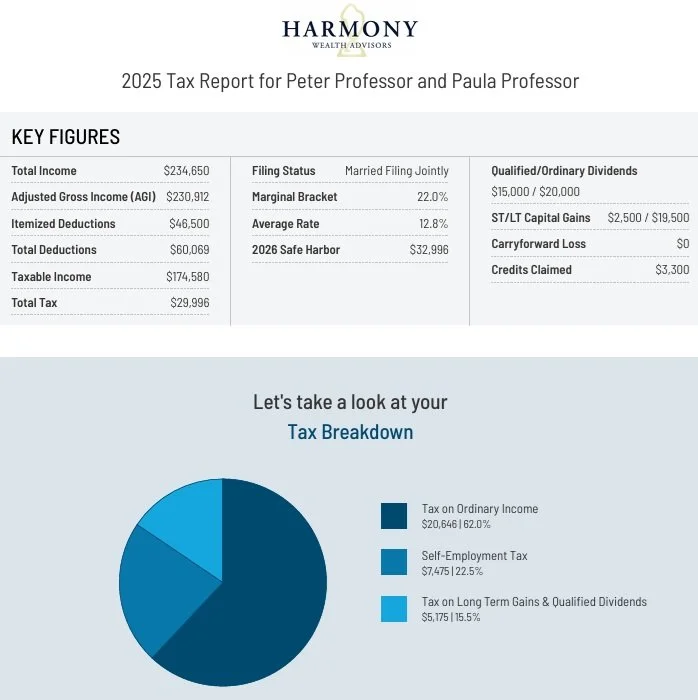
Sample Holistiplan Report: From a 60-page tax return to a clear picture
A tax return is long, dense, and written for the IRS, not for you. We use Holistiplan, a tax planning tool, to turn it into something you can use: a plain-English breakdown of where your income comes from, how it’s taxed, and where there may be room to plan.
Instead of flipping through forms, you see the return in digestible pieces: your brackets, your income sources, your deductions, and your exposure to things like capital gains. Each piece comes with actionable planning ideas to explore, such as Roth conversion room, charitable strategies, or income timing. Those ideas become the agenda for our conversations, and we review them with your CPA before anything is implemented.
The sample uses a fictional household. Real reviews are tailored to your own return.
Disclosure: Harmony Wealth Advisors, LLC does not provide tax preparation services. Tax-aware planning is educational and coordinative in nature. Please consult your tax professional regarding your specific situation. Sample reports use hypothetical information for illustration only.